
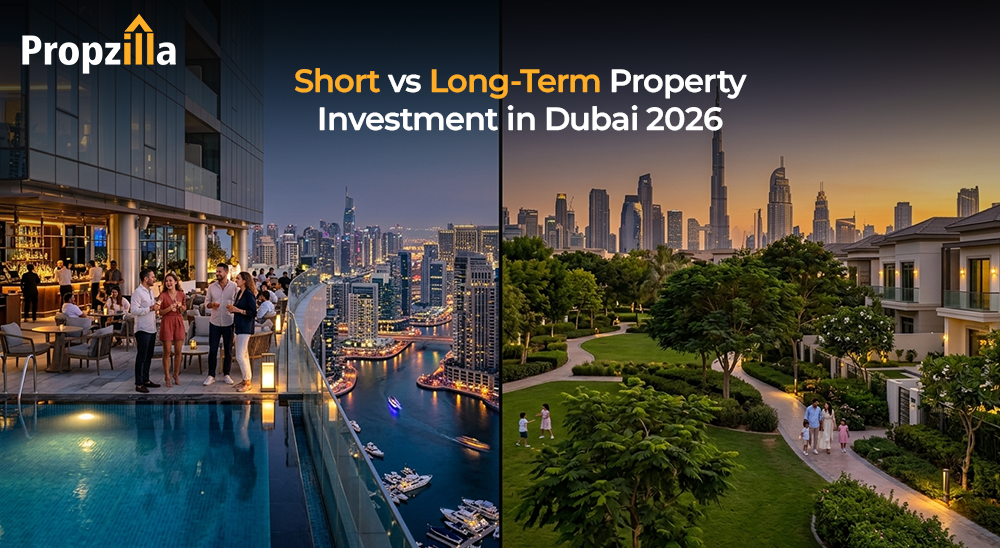
In recent years, Dubai has skyrocketed to become the world’s top market for ultra-luxury homes worth US$20 million (AED75.4 million) or more. In just the second quarter of 2025 alone, the city’s ultra-luxury property market saw sales cross US$2.6 billion (AED9.5 billion), setting new records. And that’s not all – the year also saw nearly 9,000 deals for properties worth AED10 million or more, cementing Dubai’s status as a prime property destination.
If you are evaluating your next move in the UAE, this guide breaks down exactly what works in 2026, where the highest yields are hiding, and how to choose the path that matches your financial goals.
Dubai 2026 Strategy Matrix
Before diving into the mechanics, here is a quick look at how the two models compare in today’s market
|
Feature |
Short-Term Investment (Flipping & Holiday Rentals) |
Long-Term Investment (Annual Lease & Capital Hold) |
|
Primary Goal |
Fast capital generation & high gross yields |
Stable passive income & asset appreciation |
|
Typical Yields (2026) |
7% – 12% (Gross) |
5% – 8% (Gross) |
|
Management Effort |
High (Active guest turnover / market timing) |
Low (Handled via yearly contracts / RERA) |
|
Risk Profile |
Moderate to High (Market dependency, seasonal dips) |
Low (Protected by long-term leases and mortgages) |
|
Liquidity |
Highly liquid (If flipping or selling vacant) |
Less liquid (Selling a tenanted property takes time) |
Decoding the Short-Term Strategy (Fast Capital & High Yields)
The short-term approach is explicitly designed for the active investor. You are either buying to sell rapidly (flipping) or leveraging Dubai’s massive tourism sector to generate high daily rental rates.
1. The Off-Plan Flip
Flipping involves purchasing an off-plan property at launch—often at a 10–20% discount compared to the ready market—and reselling the contract before or immediately upon the project’s handover. The 2026 Reality: Developers are now far stricter. Most tier-1 developers require 30% to 50% of the property value to be paid off before permitting a resale (No Objection Certificate).
Why do it? You can make a substantial profit using very little initial capital without ever having to manage a physical asset or a tenant.
2. Holiday Homes (Airbnb & Booking platforms)
With Dubai consistently ranking as one of the most visited cities globally, holiday lets are incredibly profitable. The 2026 Reality: The market is crowded. Earning the coveted 10%+ yield requires your property to be impeccably furnished, listed on multiple platforms, and heavily marketed. Professional operators are essentially mandatory today. Additionally, landlords must secure a strict Holiday Home Permit from the Department of Economy and Tourism (DET).
Why do it? Nightly rates during peak winter (November to March) can skyrocket, easily outperforming annual leases. Plus, you get to use your own property whenever you visit the city.
Where short-term shines best:
Downtown Dubai & Business Bay: The ultimate tourist magnets next to the Burj Khalifa.
Dubai Marina & JBR: High demand from beach-goers and digital nomads.
Palm Jumeirah: Ultra-luxury rentals where high-net-worth visitors ignore price tags.
Long-Term Strategy (Wealth Building & Zero Stress)
Long-term investment is the bedrock of real estate. You buy an asset, lease it out annually, let the rent pay off your liabilities, and wait for the natural capital appreciation of Dubai’s expanding infrastructure.
1. Annual Buy-to-Let
You lease your ready apartment or villa to a resident on a renewable 12-month contract.
The 2026 Reality: This is the safest way to invest. Tenant relations and rent increases are strictly governed by the Real Estate Regulatory Agency (RERA), ensuring stability. The tenant pays for all utilities (DEWA) and minor maintenance, meaning your 5–8% ROI is highly predictable and truly passive.
Why do it? It offers stress-free, tax-free incoming cash flow secured by post-dated cheques, heavily preferred by banks if you are seeking a mortgage.
2. Holding Off-Plan to Maturity
nstead of flipping upon handover, shrewd investors hold onto off-plan units for an extra 3 to 5 years.
The 2026 Reality: The biggest value spikes happen after a community matures. When emerging neighbourhoods finally complete their malls, metro links, and schools, the property value surges far beyond its initial handover price.
Where long-term shines best:
Jumeirah Village Circle (JVC): The king of high occupancy and excellent yields for young professionals.
Al Furjan & Discovery Gardens: Family-heavy areas with excellent metro connectivity and low tenant turnover.
Dubai Hills Estate: Premium suburban living with vast green spaces, attracting highly stable expat families.
The 2026 “Hybrid” Approach
Why choose? A massive trend in 2026 among sophisticated buyers is utilising the middle ground.
Many investors are buying properties in newly handed-over, developing communities (such as Dubai Creek Harbour or The Valley). Because the community isn’t famous enough yet for high-paying tourists, the investor places a long-term tenant in the unit to cover all service charges and mortgages. After 3 to 4 years, when the community is bustling and famous, the investor evicts the tenant (with legal notice) and either pivots to a highly lucrative short-term holiday home or sells the asset at peak capital appreciation.
The Final Verdict
The ideal investment strategy for 2026 has nothing to do with “what makes the most money” and everything to do with your available time and capital. If you are an active investor looking to maximise every dirham, want the flexibility to use a Dubai home yourself, and are targeting the glitz of Downtown or the Marina, Short-Term Strategies is your playbook. If you are an overseas buyer looking for “fire and forget” passive passive income, secured by strong tenant laws in family-oriented communities, the Long-Term Buy-to-Let approach remains one of the safest and most profitable wealth-building tools in the world.
Frequently Asked Questions (FAQs)
1. Which strategy offers the highest ROI in Dubai right now?
Short-term holiday rentals offer the highest gross ROI (often exceeding 10%). However, if you account for the expensive furnishings, DET licensing, and 15-20% property management fees, a long-term lease in a high-demand area like JVC often yields a more competitive net margin with zero stress.
2. Is off-plan flipping still safe in 2026?
Yes, but the margin for error is smaller. You must buy from highly reputable developers with a strong track record of appreciation (such as Emaar, Nakheel, or Sobha) and ensure you have the capital to hold the property if a buyer cannot be found immediately before handover.
3. Do I need special permits to rent my property?
For an annual (long-term) lease, you only need to register the contract via the Ejari system. For a short-term holding (Airbnb), you are legally required to obtain a DET Holiday Home License.
4. Who pays the utility and service charges?
In a long-term lease, the tenant pays all utilities (electricity, water, cooling). The landlord only pays the annual building service charge. In a short-term holiday let, the landlord pays for everything (utilities, high-speed Wi-Fi, cleaning, and service charges).
5. Can I easily finance a short-term rental property?
Banks heavily favour properties with long-term tenants because the predictable income covers the mortgage. Financing a property based solely on projected short-term holiday rental income can be slightly more difficult in the UAE.